If you have ever sat in the dental chair while the team steps out of the room to take an x-ray, you have probably had at least a flicker of a question: is this actually safe? It is one of the most common concerns we hear from patients in Grandville and the greater Grand Rapids area, and it deserves a straightforward answer.
The short version is yes, modern dental x-rays are considered very safe, and the information they provide plays a big role in keeping your mouth healthy. Here is a closer look at why we take them, how much radiation is actually involved, and what you can expect at your next visit.
Why Dentists Take X-Rays in the First Place
A visual exam tells your dentist a lot, but it cannot show everything. Many dental problems develop in places that are simply not visible to the eye, even with good lighting and magnification. X-rays help your dental team see:
- Cavities between teeth: Decay that forms where teeth touch often cannot be spotted until it is fairly large without an x-ray.
- Bone health: X-rays reveal bone loss from gum disease and help track it over time.
- Infections at the root: An abscess deep at the tip of a root can be invisible during a regular exam.
- Developing teeth: In children, x-rays show how adult teeth are forming and whether they are on track.
- Impacted or unerupted teeth: Wisdom teeth and other hidden teeth can be monitored before they cause trouble.
Catching these issues early almost always means simpler, more comfortable, and less costly treatment. In that sense, x-rays are one of the best preventive tools in dentistry.
How Much Radiation Is Involved?
This is where modern technology has really changed the conversation. Dental offices today typically use digital x-rays, which require dramatically less radiation than the film x-rays of decades past. The exposure from a set of digital dental x-rays is remarkably small.
To put it in perspective:
- A set of four bitewing x-rays exposes you to a fraction of the natural background radiation you absorb from the environment in a single day.
- A short airplane flight exposes you to more radiation than a routine dental x-ray.
- Everyday activities, from watching television to simply living in a brick building, expose you to small amounts of background radiation year-round.
Protective measures add another layer of reassurance. Lead aprons and thyroid collars are commonly used to shield the rest of the body, and your dental team follows the principle of taking x-rays only when there is a clear diagnostic need.
How Often Do You Actually Need X-Rays?
There is no single schedule that fits everyone. How often you need x-rays depends on your individual situation:
- Your cavity history: Patients prone to decay may need x-rays more frequently than those with a spotless track record.
- Your gum health: Periodontal concerns can call for more regular monitoring.
- Your age: Children and teens are often imaged more regularly because their mouths are changing quickly.
- Symptoms: Pain, swelling, or a cracked tooth may require a targeted x-ray right away.
Many patients with healthy mouths and low cavity risk only need routine bitewing x-rays every year or two, while others benefit from a different interval. The right answer is a personalized one, and it is always fair to ask your dentist why a particular x-ray is being recommended.
What to Expect at Your Appointment
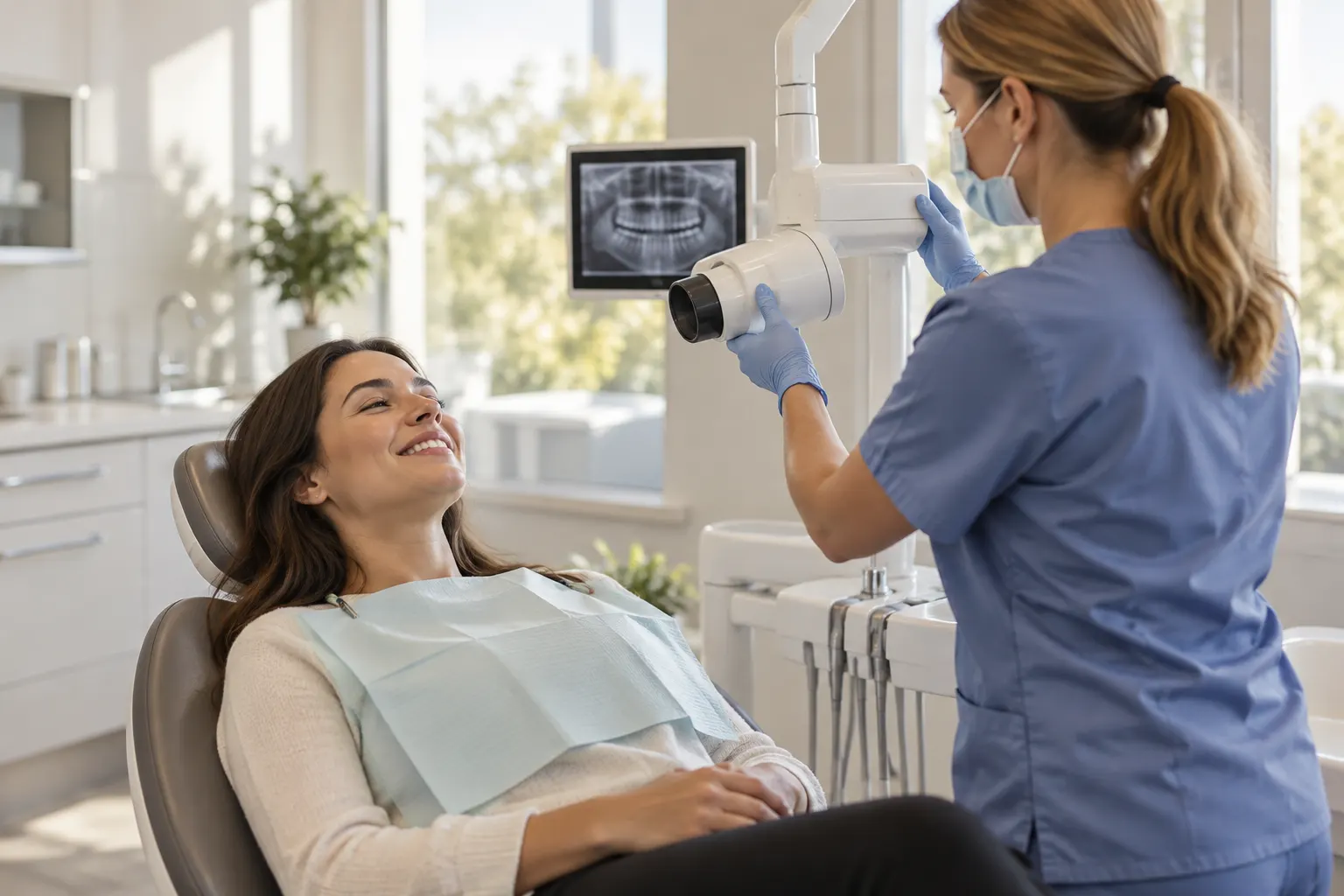
If it has been a while since your last x-ray, the process is quicker and easier than you may remember. A small digital sensor is placed in your mouth, you bite down gently for a few seconds, and the image appears on the screen almost instantly. No film, no waiting, and no uncomfortable chemical processing. Your dentist can even enlarge the image and walk you through exactly what they are seeing, which makes it much easier to understand your own oral health.
Special Situations to Mention
A few situations always deserve a mention before x-rays are taken:
- Pregnancy: Let your team know if you are pregnant or think you might be. Routine x-rays are often postponed during pregnancy, though necessary diagnostic images can be taken with shielding when a problem needs attention.
- Recent x-rays elsewhere: If another office took x-rays recently, they can often be transferred so you are not imaged twice.
- A strong gag reflex: Digital sensors come in different sizes, and an experienced team knows positioning tricks that make the process far more comfortable.
At our practice, dental x-rays are part of a thorough, prevention-first approach to care. We take only the images we genuinely need, and we are always happy to explain the reasoning behind every recommendation.
If you have been putting off a checkup because of questions about x-rays, we would love to put your mind at ease. Grandville Dental Health Center has cared for families across Grandville and the greater Grand Rapids area since 1974, and our team is glad to answer every question you bring to the chair. Request an appointment or call us at 616.531.0360.